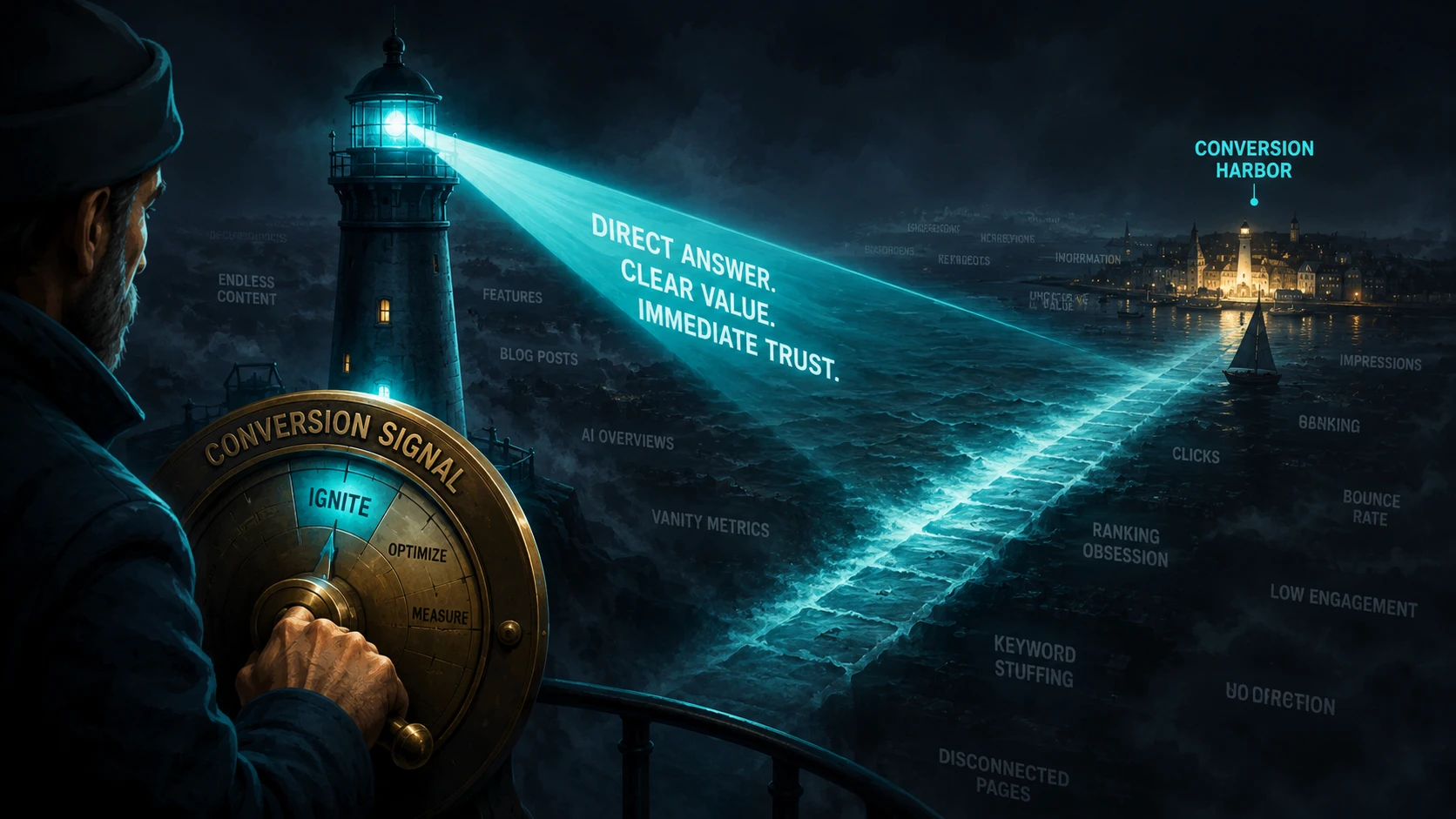
In the history of maritime exploration, the most dangerous moments weren’t found in the open ocean, but in the narrow straits where jagged reefs and unpredictable tides could wreck a ship in seconds. In the digital expedition of 2026, those reefs are known as Friction. As we established in our foundational guide to conversion, getting found is only the beginning. To reach the harbor of a booked customer, you must navigate the “Great Straight”—a frictionless path where every element of your website is engineered to move the prospect forward.
Copywriting legend Joe Sugarman introduced the concept of the “Slippery Slide.” He argued that the sole purpose of a headline is to get you to read the first sentence [1]. The purpose of that sentence is to get you to read the second, and so on, until the reader “slides” all the way to the final booking button. In the age of Intelligent Search Interfaces, this slide now begins before the user even reaches your site. To win, your brand must be the most “slide-able” option in the territory—the one that provides the least resistance to both human desire and machine logic.
Key takeaway: Conversion success is not about pushing a customer to buy; it is about removing every obstacle that prevents them from arriving at a “Yes” [2].

The Mechanics of the Slippery Slide
To build a high-conversion slide, you must understand the two forces that act upon your prospect: Momentum and Friction. Momentum is generated by the headlines that command attention and the self-interest of the reader. Friction, however, is the “sand in the gears” that brings that momentum to a halt.
In 2026, friction comes in many forms:
- Technical Friction: Slow load times or broken links that frustrate the user.
- Cognitive Friction: Vague language or “throat-clearing” that forces the reader to work too hard to find the answer.
- Process Friction: Requiring a user to fill out a 10-field contact form just to get a price.
At Bittbuzz, we apply Generative Engine Optimization (GEO) to streamline these mechanics. We ensure that your most important information—your Justification Assets—are placed at the very top of the slide. By providing the machine-readable proof that an AI needs to cite you, you ensure that the search tool itself acts as the “ignition” for the slide, delivering a pre-convinced prospect to your shore [3].
Strategy 1: The “Self-Steering” Ship (Automated Booking)
The ultimate friction-killer in the modern economy is Automation. If a prospect finds you through an AI recommendation, they are already in an “instant answer” mindset. If they reach your site only to find a message saying “We will get back to you in 24-48 hours,” the slide is broken. They will immediately return to their Intelligent Search Interface to find a competitor who can help them now.
We recommend implementing what we call the “Self-Steering” booking system. This involves:
- Real-Time Calendars: Allowing users to see your actual availability and book a slot instantly.
- Transparent Pricing: Removing the “Contact for Quote” barrier by providing clear benchmarks or calculators.
- Instant Confirmation: Providing immediate feedback that the journey is complete.
This level of efficiency is a powerful Entity Signal. When an AI crawls your site and sees a functional, real-time booking framework, it records your business as a high-reliability entity, making it significantly more likely to recommend you for “Urgent” or “High-Intent” queries [4].

Strategy 2: The 40-Word Lead as a Slipway
In our guide on the power of original data, we discussed how specificity builds authority. From a conversion perspective, the way you present that data is what maintains the slide’s momentum.
We use the 40-word lead technique to act as a “Slipway” for the reader. By providing a concise, factual summary at the start of every section, you eliminate the cognitive friction of searching for the point.
- Frictional Writing: “In this section, we are going to look at several different ways that businesses can improve their booking rates, which is a very important part of modern digital marketing strategy…”
- Slippery Writing: “Eliminating process friction increases booking rates by 30%. By implementing real-time calendars and 40-word leads, you provide the ‘Justification Assets’ that both AI and humans need to make a fast decision.”
The second example is “Machine-Readable.” It tells the Intelligent Search Interface exactly what the value is, allowing it to “slide” your brand name directly into the user’s answer. This process is essential for maintaining the “Citation Share” we cover in our guide on why brand reputation matters more than links now.
Strategy 3: Eliminating Choice Paralysis (The Single Course)
One of the most common causes of friction on a professional website is “Choice Paralysis.” When a navigator is in a storm, they don’t want a list of ten possible ports; they want the best port.
If your service page offers too many options, tiers, and add-ons without a clear “Recommended” path, the prospect will stall. To keep the slide slippery, you must provide a Direct Directive.
- Lead with the Solution: Don’t sell a “Audit”; sell “Total Visibility.”
- Highlight the ‘Expert Choice’: Tell the reader exactly which path most clients take.
- Minimize CTA Competition: Every page should have one primary goal. If you want them to book a call, don’t also ask them to sign up for a newsletter and follow you on social media in the same space.
| Friction Level | User Experience | AI Perception |
|---|---|---|
| High Friction | Confusing, slow, too many forms | Low-Trust Entity |
| Low Friction | Clear path, fast, one-click booking | Verified Authority |
| The ‘Slippery Slide’ | Effortless, informative, instant result | Primary Recommended Source |

Conclusion: Mastering the Flow
Digital conversion in 2026 is an engineering challenge. Success is no longer about the “hard sell”; it is about the “hard solve”—identifying every point where a customer might hesitate and smoothing it over with data, speed, and automation [5]. By engineering a Slippery Slide, you ensure that the momentum generated by your visibility strategy isn’t wasted.
At Bittbuzz, we don’t just help you get found—we help you get booked. We build the automated slipways and the technical foundations that make your brand the easiest, most logical choice in the modern search landscape.
Immediate steps for your conversion slide:
- Audit your mobile site: Can a user book a service in three clicks or less?
- Replace “Contact Us” with a direct link to an automated calendar.
- Rewrite your top 3 service descriptions using a 40-word, data-rich lead.
To see how this frictionless flow integrates with your overall search strategy, we recommend exploring our guide on Local Search vs AI Answers. Learn how to use instructional content for conversion to turn your streamlined path into a proven authority signal.