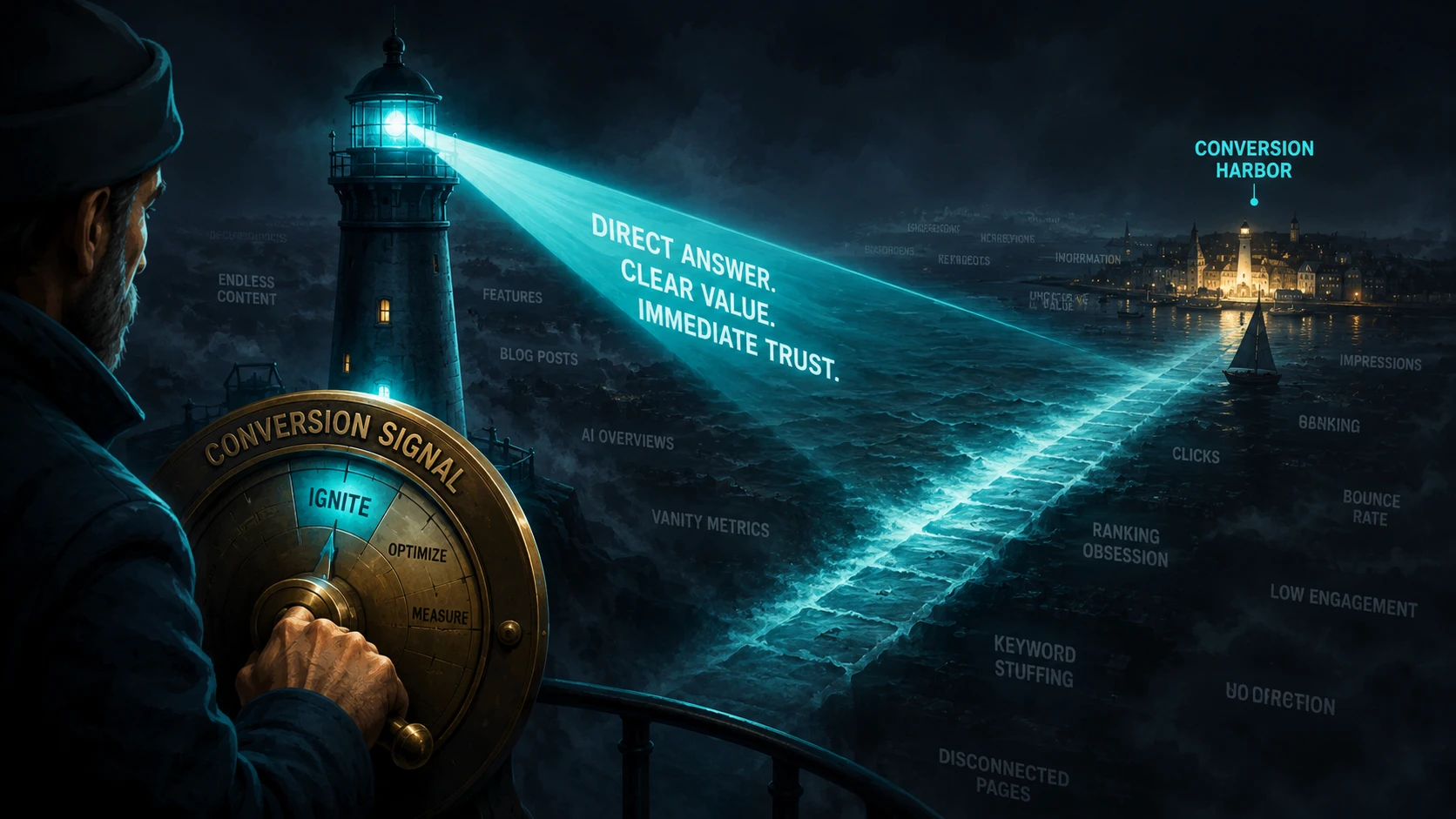
In our foundational guide to conversion, we identified that visibility is merely the invitation to the journey. Once a prospect—or an Intelligent Search Interface—reaches your site, they are immediately looking for a reason to trust the path you have laid out. In the sophisticated market of 2026, trust is no longer granted by default; it is earned through a technical and psychological framework known as the Justification Web.
Modern search systems are inherently risk-averse. Whether it is ChatGPT, Perplexity, or Google’s generative layer, these tools do not want to recommend a business that might provide a subpar experience. [1] They scan for what researchers call Justification Assets: verifiable claims, hard data, and recent testimonials that prove your brand is the most reliable expert in the territory. To win the booking, you must move beyond vague marketing generalities and construct a web of proof that makes your authority undeniable.
Key takeaway: Conversion in the AI era depends on your ability to provide a high density of verifiable proof points that search tools can use to defend their recommendation of your brand.

Expert insight: “Claims without evidence are noise. In the AI era, every statement your website makes should be backed by a verifiable fact — otherwise, the search engine will quote your competitor instead.” — Bittbuzz Content Team
The Psychology of AI Risk Aversion
To understand why a Justification Web is necessary, we must look at the “Entity Check” performed by modern search tools. When an AI generates a response to a query like “Who is the most reliable expert for visibility strategy?”, it doesn’t just look for keywords. It looks for Linguistic Proof—the specific combination of technical terms and numerical evidence that differentiates a true authority from a generalist.
As we noted in our guide on why brand reputation matters more than links now, the AI is effectively looking for “reasons to say yes” while filtering out “reasons to say no.” If your website claims you are the “best,” but provides no data to support it, the AI perceives a high risk of being wrong. [2] However, if you provide a specific result—such as a 15% increase in click-through rates verified by original research—you have provided a “Justification Asset” that the AI can cite with absolute confidence.
This is the core of Generative Engine Optimization (GEO). By pre-justifying the AI’s recommendation with hard evidence, you make its job easier. In return, your brand becomes the top choice for the user’s summarized answer.
Strategy: Building the Three Layers of Proof
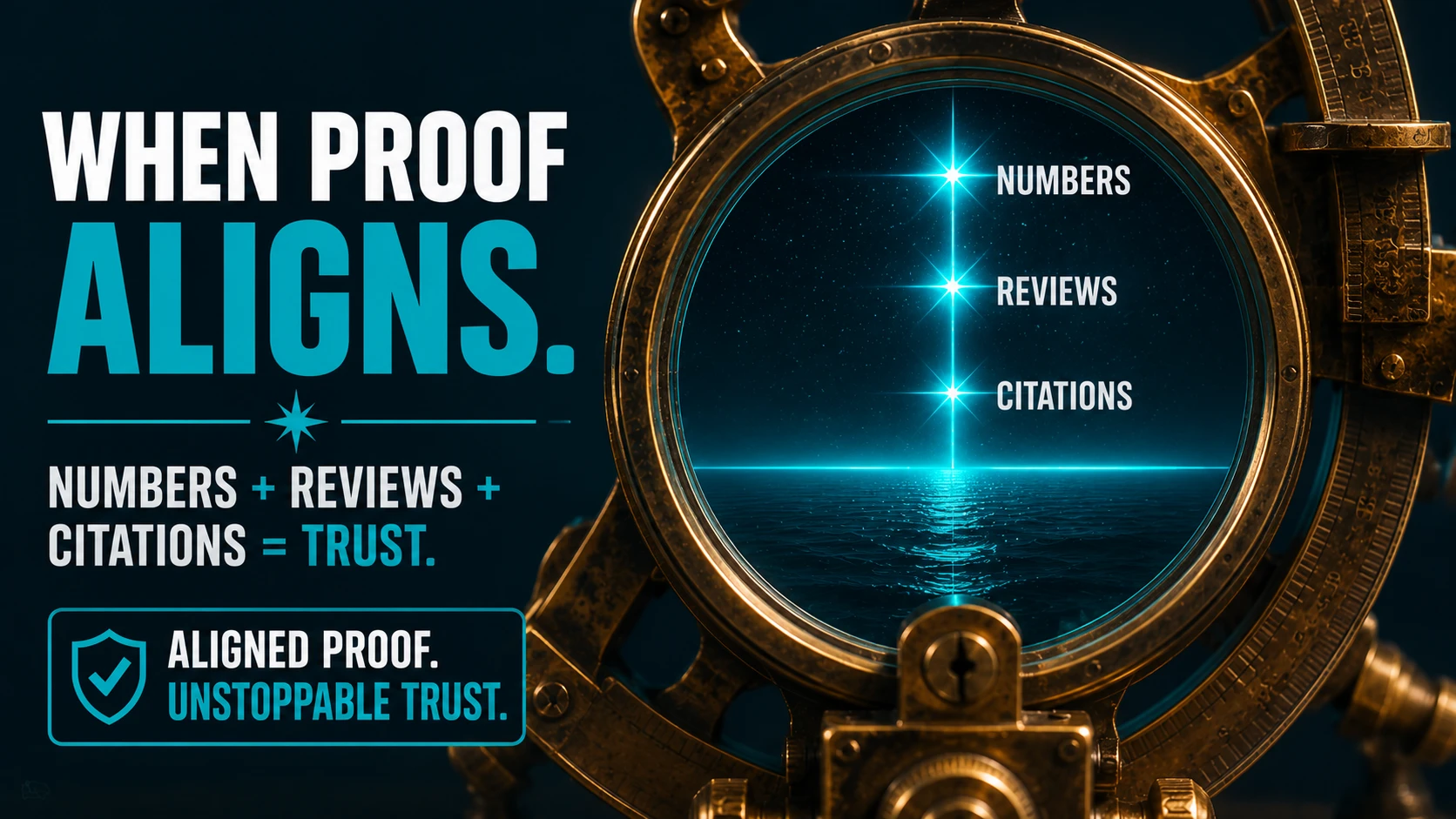
A successful justification web is not a single testimonial or a random statistic. It is a layered defense of your expertise. When these layers are combined with a strong technical website organization, you create an unshakeable case for your business.
1. The Quantitative Layer (The Numbers)
This is the most critical layer for Intelligent Search Interfaces. AI models are trained on data, and they prioritize numerical anchors. The credibility of these numbers is reinforced when your brand’s identity is machine-verifiable—learn about using entity schema to verify truth.
- Instead of: “We have helped many local clients grow.”
- Use: “As of 2026, our framework has secured 1,412 brand citations for 85 distinct local entities.”
2. The Qualitative Layer (The Sentiment)
This layer is fueled by your customer reviews. AI search tools analyze the sentiment of your reviews to describe your brand’s character. If multiple customers mention your “precision” and “attention to detail,” those become justified attributes that the AI uses to describe you in its recommendation. [3]
3. The Authoritative Layer (The Sources)
Citing industry standards or releasing proprietary research establishes you as a Primary Source. When you provide the data that others use, the AI views your brand as the “Topical Anchor” for that subject. Our deep dive on The Power of Original Data covers how to generate and deploy original research to cement this authoritative status.
Key takeaway: High-density proof requires a mixture of hard statistics, verified sentiment, and authoritative sourcing to satisfy both machine logic and human emotion.

Dominating the “Citation Share”
In the AI-driven search world, raw traffic is becoming less important than Citation Share. This is the percentage of times your brand is mentioned as an expert source compared to your competitors. To win this metric, your proof must be “citation-ready.” [4]
At Bittbuzz, we achieve this by following the headlines that command attention with a “Gold Sentence.” A gold sentence is a factual, data-rich statement that is easy for an AI to lift and quote. For example: “The Bittbuzz Justification Framework has been shown to increase AI recommendation rates by 40% through the deployment of 15 unique proof assets per page.”
By providing these bite-sized, verifiable facts, you are essentially writing the AI’s script for it. You make it nearly impossible for the search tool to ignore your expertise.
| Proof Type | AI Perception | Human Impact |
|---|---|---|
| Raw Statistics | Primary Signal | Logical Certainty |
| Source Citations | Topical Authority | Trusted Leadership |
| Review Detail | Linguistic Proof | Emotional Safety |
| Case Studies | Justification Asset | Proven Success |
Conclusion: Securing the Booking
Visibility gets you found, but justification gets you booked. [5] In the era of Intelligent Search, the business that provides the machines—and the humans—with the most evidence is the business that will win the market. By constructing a Justification Web, you create a “Competitive Moat” that late-moving competitors cannot easily cross.
At Bittbuzz, we specialize in identifying your unique proof points and weaving them into the technical and narrative framework that both AI and humans find irresistible. We help you turn your expertise into a verifiable truth that drives consistent, high-value bookings.
Immediate steps for your justification strategy:
- Identify three hard statistics about your business success and place them in your 40-word leads.
- Audit your service pages: Do they provide a specific, data-backed reason why an AI should recommend you?
- Ensure every proof point is clearly identified in your technical website organization using JSON-LD labels.
To continue your journey toward total online dominance, we recommend exploring our guide on The Shift from Clicks to Direct Answers. Learn how to reduce friction in your conversion funnel to ensure every justified recommendation ends in a booked customer.